

A
Phase 01Discover
Map the operational truth before a line of build work starts.
Off-the-shelf platforms rarely reflect real workflows. The difference is how they are extended, integrated, and shaped to meet operational, regulatory, and customer experience requirements.
UCT designs and delivers software shaped around the operation — not adapted to it. Custom middleware, API integration, workflow automation, and compliance logic are structured from the initial design phase — not added later. Across regulated markets in the UK and EMEA, UCT builds to the constraints of the business: the processes, the regulatory environment, and the systems already in place.
Off-the-shelf platforms get you most of the way. The rest — the workflows, the integrations, the regulatory and CX nuances that define the business — only ever lives at the seams. Our work is to engineer those seams: extending platforms, integrating systems, and shaping behaviour to fit how the business actually operates.
Standard configuration covers the standard case. The real operation is in the exceptions, the rules, and the systems that have to talk to each other.
Where platforms meet real workflows is where extension, integration, and disciplined development do the work no toggle can.
A modern SDLC applied to communication, CX, and AI integration — focused on business outcomes rather than engineering ceremony.
Map the operational truth before a line of build work starts.
Shape an architecture that fits the business, systems, and controls.
Engineer the integrations and extensions with disciplined delivery.
Prove the workflow against data, resilience, and compliance.
Release with control, then tune against measured outcomes.
Understand the workflow, the systems, the data, and the rules the business actually runs on.
Translate operational reality into an integration and extension design that fits — not one that forces a fit.
Develop the integrations, extensions, and middleware against clear specifications and disciplined engineering practice.
Prove the design against real workflows, real data, and real compliance requirements before it touches the business.
Release into production with control, then tune against measured outcomes — not assumed behaviours.
Systems shaped to the way the business actually operates — not the way the platform assumed it should.
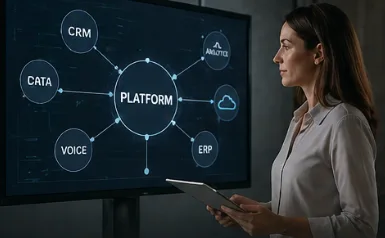
CRM, voice, AI, ticketing, and back-office data connected so information moves with the work.
Decisions, alerts, and customer interactions powered by the freshest signal, not a nightly export.
Repetitive copy-paste, swivel-chair work, and spreadsheet stitching engineered out of the day.
Consent, suppression, retention, and approvals enforced by the system — not enforced by hope.
A pattern-based integration estate that extends to new regions, products, and workflows without rebuilding.
Frontline teams stop fighting the system. The information they need is in the right place, the actions they take are recorded automatically, and the workarounds quietly disappear.
Operations and IT inherit a coherent set of integrations, services, and controls — designed to be observed, supported, and extended without unpicking the build.
Leadership sees platforms doing the specific work the investment was made for — efficiency gained where it was promised, compliance evidenced where it is required, and experience consistent where it is judged.
The work is rarely the happy path. It is in the limits of vendor APIs, the edges of compliance, and the boundary conditions that demos quietly skip past.
Vendor APIs that almost cover the use case — until they do not. The work lives in those gaps.
CRM, voice, AI, ticketing, billing, and back-office data each with their own model, rate limits, and quirks.
Consent, suppression, retention, and conduct rules that need to be enforced inside the workflow, not around it.
How information moves, where it lands, who owns it, and how it stays accurate as it travels.
Different roles see different things — designed deliberately, not as an afterthought.
When integrations fail quietly, the business pays loudly. Monitoring is part of the build.
APIs change, vendors change, requirements change — the integration estate has to absorb that.
Tokens, certificates, and credentials handled the way regulated environments expect.
When platforms are extended and integrated with discipline, the change shows up in efficiency, in compliance posture, and in the experience customers actually receive.
Manual effort engineered out of the day so the team focuses on work that needs them.
Rules enforced inside the workflow — evidence generated automatically.
Real-time signal across systems, not nightly batches and inboxes.
Customer journeys that match what was designed, end to end.
A pattern-based integration estate that grows without rework.
Less duplication, less rekeying, less remediation — visible in the run cost.
Delivered using trusted global partners.
We use analytics cookies to improve website performance and user experience. You can accept or reject optional analytics cookies. See our Cookie Policy for more information.