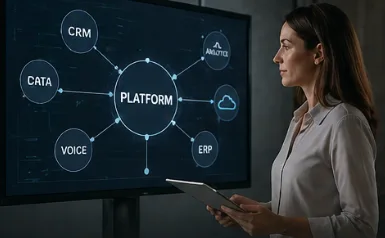
Customer experience doesn't break at the channel. It breaks in the operation behind it.
Every interaction depends on having the right people, at the right time, performing at the right standard.
UCT helps organisations align workforce management and quality management into one operating model — designed for the way modern customer experience is actually delivered.

Most contact centres are not failing because of technology. They are failing because of coordination.
Customers feel the operational gaps before they feel the platform behind them.
This is not a tools problem. It is an operating-model problem.
- 01Staffing rarely matches demand.Forecasts drift from reality, leaving teams overstretched at peaks and underused in lulls.
- 02Quality is sampled, not understood.Manual scorecards capture a fraction of conversations and rarely change behaviour at scale.
- 03Performance gaps stay invisible.Coaching is shaped by anecdote because there is no shared evidence of what good looks like.
- 04Operations react instead of anticipate.Daily fire-fighting replaces structured planning, and the same problems return week after week.
Two disciplines. One operating model.
Workforce Engagement Management aligns Workforce Management and Quality Management so capacity, performance, and customer experience move as one.
The right people, at the right time, with the right capacity.
- ForecastingVolume modelling grounded in real demand patterns, not last quarter's averages.
- SchedulingShift design that balances service levels with team wellbeing and skills coverage.
- AdherenceReal-time visibility of how the day is actually running compared to the plan.
- Staffing optimisationContinuous adjustment as demand, skills, and operating context change.
Consistent standards across every conversation, not just sampled ones.
- Interaction analysisConversations interpreted at scale, surfacing themes, risk, and customer sentiment.
- ScoringStructured evaluation aligned to the standards that actually matter to the business.
- CoachingTargeted, evidence-led development tied to what is happening on the floor.
- Performance improvementA continuous feedback loop between insight, coaching, and operational outcome.

One operating model. Three perspectives.
Workforce engagement works when the needs of frontline teams, supervisors, and leaders are designed together.
Agents & Team Members
Work with fairer schedules, clearer expectations, and coaching that reflects real customer conversations.
Supervisors
See demand, adherence, quality, and performance patterns clearly enough to support teams in the moment.
Operations Leaders
Balance service levels, cost, compliance, and wellbeing through one operating view of the workforce.
Operating reality looks different in every sector.
The same WEM model adapts to the operating constraints, regulation, and customer profile of the industry it serves.


Operational design, measurable outcomes.
When workforce planning and quality oversight move together, the business sees the change in efficiency, performance, compliance, and the experience customers actually receive.
Operational Efficiency
Match capacity to demand and remove the cost of structural over- and under-staffing.
Stronger Performance
Coach against real interactions to lift the floor, not just celebrate the ceiling.
Compliance Confidence
Evaluate regulated conversations consistently and demonstrate it on demand.
- 04Better Customer ExperienceDeliver a more consistent service across teams, regions, and channels.
- 05Engaged TeamsFairer schedules, clearer expectations, and better-supported development.